Have We Mistaken Information for Education?
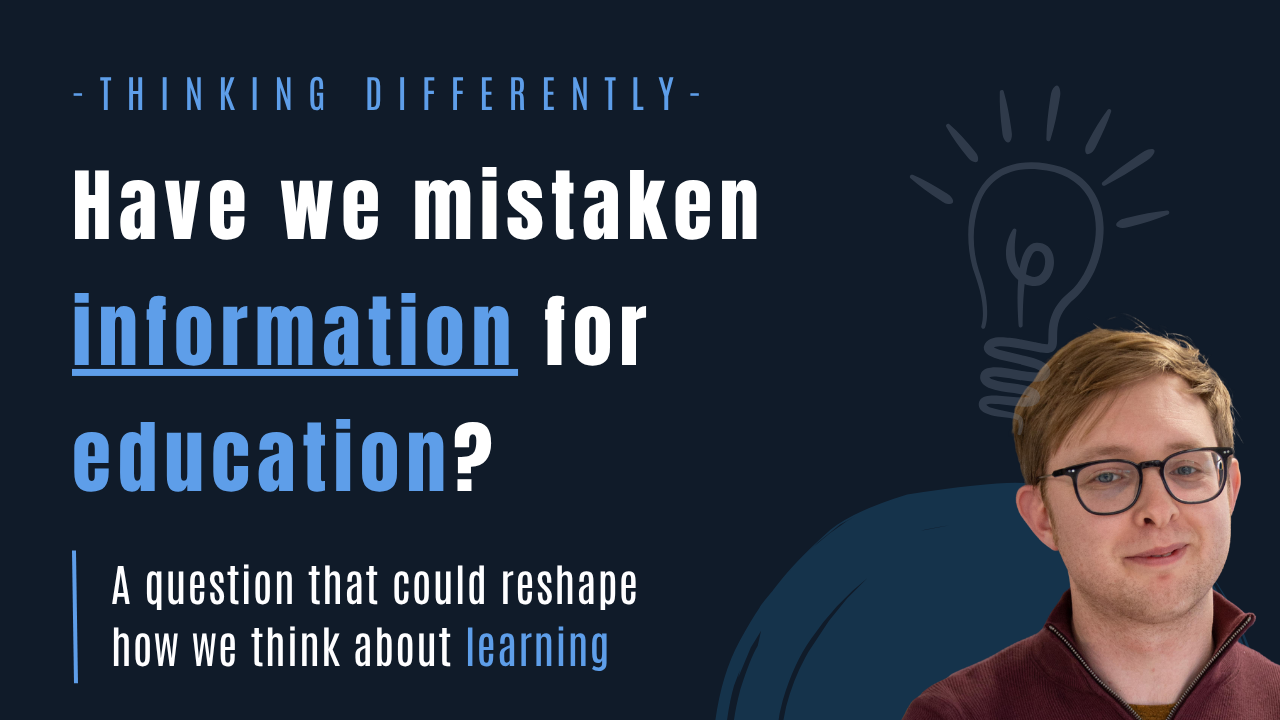
What if we've accidentally mistaken information for education?
It's a question that has lingered in my mind ever since. Every conversation with parents, every discussion with teachers, every business meeting and every article I read about artificial intelligence seems to bring me back to it. For decades, education has largely been built around the acquisition of knowledge. We measure success by how much information a student can recall in an exam. Schools are judged by results. Universities select applicants by grades. Employers often filter candidates by qualifications.
For a long time, this made perfect sense. Information was valuable because it was scarce. If you wanted to understand history, you visited a library. If you wanted to solve a complex maths problem, you reached for a textbook. If you needed expert knowledge, you sought out someone who had spent years acquiring it. Knowledge gave people an advantage.
Today, however, we find ourselves living in a completely different world. Within seconds, almost every piece of information humanity has ever recorded can be accessed from a device that fits comfortably into our pocket. Artificial Intelligence can explain complicated scientific theories, generate lesson plans, summarise entire books, translate languages and even write computer code in moments. The world has changed. So, the question is...has education changed with it?
Information has become abundant
There has never been a better time in history to access information. This isn't something we should fear; it's something we should celebrate. Knowledge has become more democratic than ever before. A child in a small village now has access to many of the same educational resources as a child attending one of the world's leading schools. That's extraordinary. Yet despite this incredible transformation, many educational systems still operate as though information remains the scarce commodity it once was.
Children continue to spend countless hours memorising facts that can be retrieved almost instantly. Teachers often feel pressured to cover ever-expanding curricula. Parents understandably become anxious about grades because those grades remain the currency by which success is measured. None of these people is doing anything wrong. They're simply operating within a system designed for a different era.
Knowing isn't the same as understanding
One of the biggest misconceptions in education is the belief that knowing something automatically means understanding it. We've all experienced this. Many of us can remember learning mathematical formulas at school. We could reproduce them during an exam, yet years later, many of those formulas have disappeared from memory. Did we ever truly understand them? Or did we simply remember them long enough to pass a test?
Real understanding looks very different. Understanding allows someone to transfer knowledge into unfamiliar situations. It allows them to question ideas, challenge assumptions, connect concepts, and solve problems that don't already have an answer printed in the back of the textbook. That's a very different skill. Unfortunately, it's also far more difficult to assess. Remembering information is relatively straightforward to measure. Understanding requires conversation, reflection, creativity and application. Ironically, these are often the very things squeezed out by accountability pressures.
AI isn't replacing thinking
Much of the conversation surrounding Artificial Intelligence focuses on replacement. Will AI replace teachers? Jobs? Graduates?
Personally, I think these questions miss the point. AI doesn't remove the need for thinking; it changes where human thinking becomes most valuable. When answers become almost limitless, the real advantage shifts towards asking better questions. Curiosity, judgement, creativity, communication, and emotional intelligence become more valuable. These have always mattered. They're simply becoming impossible to ignore.
The skills we can't outsource
Imagine two students leaving school ten years from now. The first has excellent grades. The second has slightly lower grades but demonstrates exceptional communication, resilience, curiosity and the ability to solve unfamiliar problems. Which student is likely to thrive throughout a forty-year career?
Increasingly, I suspect it's the second. Not because knowledge doesn't matter. It absolutely does, but because knowledge is now only one ingredient. The ability to adapt has become equally important. Technology will continue changing, industries will continue evolving, and jobs will appear that don't currently exist.
The people who flourish won't simply be those who know the most. They'll be the people who continue learning.
I see exactly the same thing in business
Interestingly, I encounter precisely the same pattern outside education. Over the past few years, I've had the privilege of growing a business, building a team and gradually stepping away from day-to-day delivery to focus on leadership and strategy. One thing has become abundantly clear: Success isn't determined by who possesses the most information. Information is readily available; books, podcasts and AI exist.
The founders who continue growing are usually those who make better decisions. They know when to recruit, delegate, change direction and say no. Leadership isn't an information problem. It's a judgement problem. That's why simply consuming more content rarely transforms a business. Transformation happens when someone changes how they think.
Education has always been deeply human
Despite all the conversations about technology, I don't believe education is becoming less human. I actually think it's becoming more human. The best teacher I ever had wasn't memorable because they knew the curriculum better than everyone else. They were memorable because they believed in me, noticed strengths I couldn't yet see, challenged me, encouraged me, and made me feel capable.
Years later, I can't remember every lesson they taught, but I remember how they made me feel. That has always been education's greatest gift. No search engine can replicate genuine encouragement. No AI model can replace a trusted adult who sees potential before a child sees it themselves.
Have we been measuring the wrong things?
Perhaps this is where the biggest challenge lies. Our systems often reward what is easiest to measure. Grades. Attendance. Progress scores. Exam results. These things certainly matter, but do they tell the whole story?
Imagine asking different questions: Has this young person become more curious? Do they understand themselves better than they did a year ago? Can they communicate confidently? Can they build healthy relationships? Can they recover after failure? Can they solve unfamiliar problems?
These are arguably the qualities that determine success throughout adult life, yet they rarely receive the same attention as examination performance.
The purpose of education
This brings me back to my original question: What is education actually for? Is it simply the transmission of information? Or is it something much deeper? Perhaps education has always been about helping people become more fully themselves. Helping them discover strengths. Develop character. Build confidence. Learn how to contribute. Find purpose. Acquire wisdom rather than simply information.
If that's true, then AI doesn't threaten education. It simply forces us to remember what education was always supposed to be.
A different future
I suspect that twenty years from now, the most successful schools won't necessarily be those producing the highest examination results. They'll be the schools producing adaptable, thoughtful, compassionate young adults who know how to keep learning long after formal education ends. Likewise, the most successful organisations won't simply recruit the cleverest people. They'll recruit those who collaborate well, communicate clearly, remain curious and embrace change. These qualities are becoming our greatest competitive advantage.
Whether I'm speaking with parents, working alongside schools or mentoring business founders, I keep arriving at the same conclusion: The future won't belong to those who simply know the most. It will belong to those who know how to think, how to learn, how to adapt and how to help others do the same. Information has never been more accessible. Understanding has never been more valuable. Perhaps the question isn't whether AI will change education. Perhaps the real question is whether this moment gives us permission to remember what education was meant to be all along.
Because education has never really been about filling minds with facts. At its very best, it has always been about shaping human beings.